御嶽山に関する研究成果の紹介(前田裕太)

My researches of Mt. Ontake volcano, Japan (Yuta Maeda)


このページでは御嶽山に関する私の研究成果を一般向けに紹介します。
This site introduces my researches of Mt. Ontake volcano, Japan, for general society.

これまでの私の研究から、御嶽山に関して以下のことが分かってきました。
My previous researches have revealed the following viewpoints of Mt. Ontake.

○新期御嶽—古期御嶽—基盤岩の3層構造 (Three-layer structure composed of younger and older eruptive deposit layers underlain by the basement)

御嶽山では78〜39万年前の活動期(古期御嶽)の後、 おおよそ30万年間の休止期を挟んで10万年前から始まった活動(新期御嶽) が現在まで続いています。 このこと自体は別の研究者が行った地質調査によってもともと分かっていました。 しかし地質調査で分かるのは地表面での噴出物の分布ですので地下がどうなっているかは分かりません。 そこで私の研究では地震波の伝わり方を使って地下構造を調べ、 新期御嶽や古期御嶽の噴出物が分布するおおよその深さ範囲と それぞれの層をP波が伝わるおおよその速さを明らかにしました(表1)。
Mt. Ontake has been active from 0.78 to 0.39 million years (MA) and from 0.1 Ma to now (older and youger activities, respectively). This knowledge has been discovered by a geological survey by other researchers; however, the geological survey does not resolve the subsurface distributions of eruptive deposites. My subsurface structural survey based on the propagation of seismic wave revealed approximate depth ranges of the younger and older eruptive deposits (YED and OED, respectively) and approximate P-wave velocities in these layers (Table 1).

表1. 御嶽山浅部のおおよその地下構造。
Table 1. Approximate subsurface structure of the shallow subsurface of Mt. Ontake.
層
Layer
おおよその標高範囲(海抜、m)
Approximate elevation range (above sea level, m)
おおよそのP波速度(km/秒)
Approximate P-wave velocity (km/s)
新期御嶽(10万年前以降)の噴出物層
Younder (< 0.1 Ma) eruptive deposit layer (YED)
> 1900 2.4
古期御嶽(78〜39万年前)の噴出物層
Older (0.78-0.39 Ma) eruptive deposit layer (OED)
900-1900 3.6
基盤岩(火山噴出物が堆積する前の元々の岩盤)
Basement (original rock layer existed before volcanic activity)
< 900 5.6

○熱と流体の供給源 (Heat and fluid sources)

御嶽山は水蒸気噴火を起こす火山ですので水と熱源がどこかにあるはずです。 どこにあるのでしょうか? 水に関しては雨が地下に染み込んで地下水となることも考えられますが、 それだけでは噴火を起こせないので熱源がどこかに必要です。 まだはっきりしたことは言えませんが、 地震波を使った私の研究と、別の方法を使った他の研究者によるいくつかの研究との合わせ技により、 どうやら海水準付近(御嶽山は標高3067 mですので地表からの深さで言えば約3 kmになります) を上端とするマグマだまりがありそうだということがおぼろげながら見えてきました。 どろどろに溶けた高温のマグマだまりよりは、 比較的低温の、ほぼ固体になりかけたマグマだまりを想像する方が良さそうです。 比較的低温と言っても「マグマだまりにしては」低温という意味ですので、 雨水に由来する地下水よりはもちろん高温です。 マグマの液体部分には水や二酸化炭素などの揮発性成分(気体になりやすい成分)が溶け込んでおり、 マグマが冷えて固体の岩石になるときに溶けきれなくなって排出されます。 これらの流体(気体や液体など流れるものの総称)は 排出直後にはマグマと同じ温度ですので雨水由来の地下水よりも高温です。 この高温流体がマグマから分離して地下を上昇し、もともと存在した地下水を温め、 水蒸気噴火の大元の原因になっているのではないかと想像されます。
The occurrence of phreatic eruptions at Mt. Ontake suggests the presence of water and heat source, but where are they? Groundwater from the rain may be one candidate for the source of water, but heat source is necessary to realize eruptions. My researches based on seismic wave, combined with researches done by other experts based on different observations, suggest the potential presence of a magma reservoir roofed at around sea level, which is approximately 3 km deep from the summit of Mt. Ontake (3067 m). This magma reservoir is likely filled with relatively low-temperature, mostly solified magma rather than high-temperature magma with large liquid fraction; note, however, that even if it is relatively low temperature as magma, it is still hotter than underground water from the rain. Volatiles such as water and carbon dioxicide are exsolved in melt and exsolve when the magma solidifies. The exsolved fluids have the same temperature as magma and thus hotter than underground water from the rain. A possible scenario is that this high-temperature fluid is separated from the magma and migrates upward, heating the existing underground water, and ultimately causing phreatic eruptions.

○古期御嶽層は流体を通しにくい (OED has small permeability)

古期御嶽は大昔(おおよそ40万年以上前)の噴出物です。 その上には新期御嶽の噴出物が乗っていますので、 古期御嶽層は荷重を長期間受け続けて隙間の少ない硬い岩盤になったであろうと想像できます。 そのような岩盤は地下水や火山ガスなどの流体を通しにくいと考えられます。 実際に湧水量の空間分布を調べた研究があり(私の研究ではありません)、 新期御嶽—古期御嶽境界付近で大量の湧水が見られることから 古期御嶽上面に沿った地下水流動が示唆されています。 また、後述する御嶽山2014年噴火直前の膨張源や地震の震源に関する私の解析結果からも 古期御嶽層が流体を通しにくいことを支持する解析結果が得られています。
The OED was formed in many (more than approximately 0.4 Ma) years ago and overlain by the YED, suggesting that the OED is rigid, poor in pores, and thus has a small permeability. This scenario is supported by a study of groundwater flow (not mine); large amount of spring water along the YED-OED boundary suggests groundwater flow along the boundary. My researches on the source of inflation immediately before the 2014 eruption and hypocenters of earthquakes, described layer, support the senario of low-permeability OED.

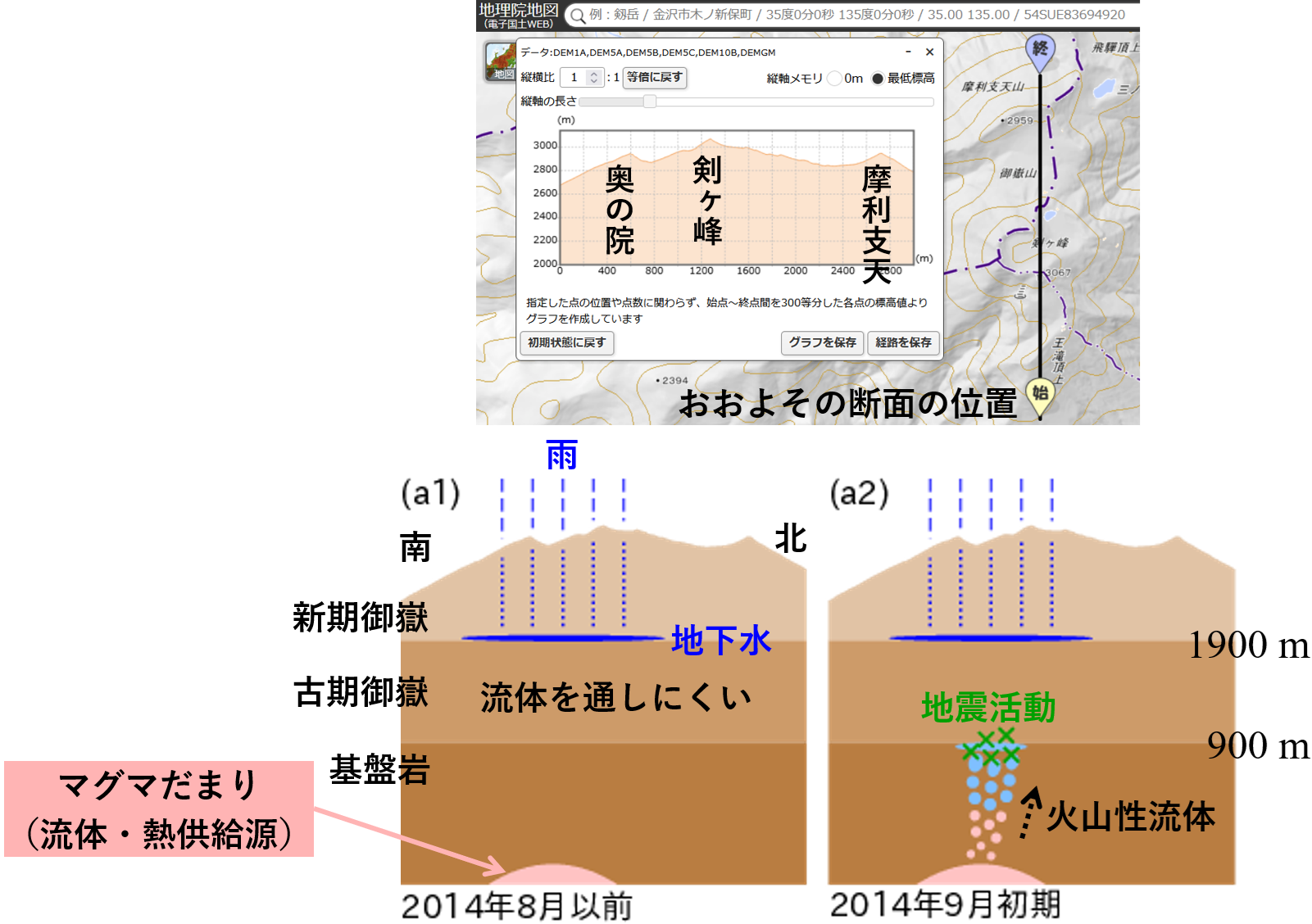
ここまでに述べたことをまとめると図1のようになります。
Fig. 1 summarizes the findings described so far.


図1. 御嶽山の3層構造と流体・熱供給源の模式図。 上段は断面のおおよその位置を表したもので地理院地図に加筆、下段は Maeda et al. (2026)の図を修正。
Fig. 1. Schematic illustration of the three layers and the fluid and heat sources of Mt. Ontake. The top panel shows an approximate location of the transect annotated on the map issued by the Geospatial Information Authority of Japan; the bottom panel was modified from Maeda et al. (2026).

○2014年噴火で古期御嶽層の一部が破壊された (OED was partially destroyed by 2014 eruption)

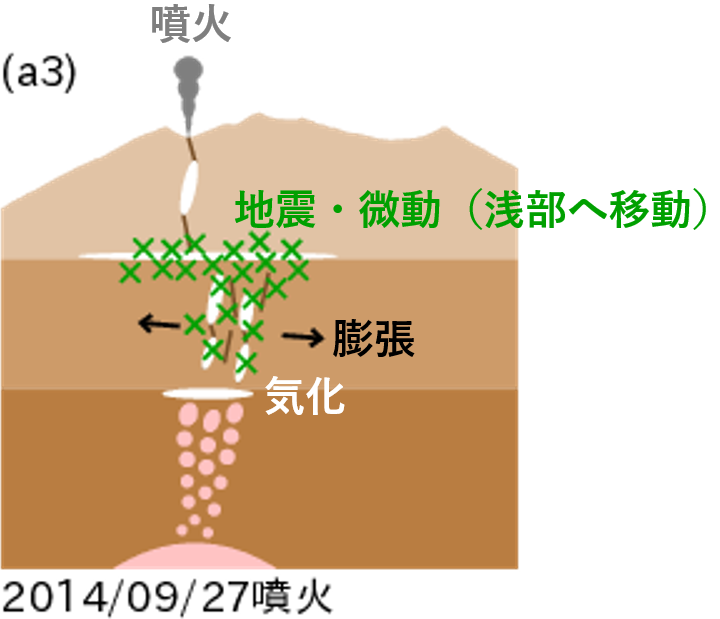
御嶽山2014年噴火は9月27日11時52分頃に開始しました。 その約7分前(11時45分頃)から多数の地震を伴って山体が急激に膨らむ動きが記録されました。 詳細なデータ解析から、この膨張は地下水が加熱されて急激に気化し、 それによって生じた水蒸気が古期御嶽層を割って通路を作りながら上昇したことで起きた と推定されました(図2)。
The 2014 eruption of Mt. Ontake started at around 11:52 on September 27. Approximately seven minutes before (~ 11:45), rapid inflation of the volcano was recorded, associated with a burst of seismicity. Detailed data analysis suggested that the inflation was caused by rapid vaporization of heated underground water and upward migration of resultant water vapor creating its pathway by rupturing the OED (Fig. 2).


図2. 御嶽山2014年噴火過程の模式図。 Maeda et al. (2026)の図を修正。
Fig. 2. Schematic illustration of the 2014 eruption of Mt. Ontake; modified from Maeda et al. (2026).

○噴火以降の地震の多くは新期御嶽—古期御嶽境界付近で起きている (Post-eruptive earthquakes are clustered around the YED-OED boundary)

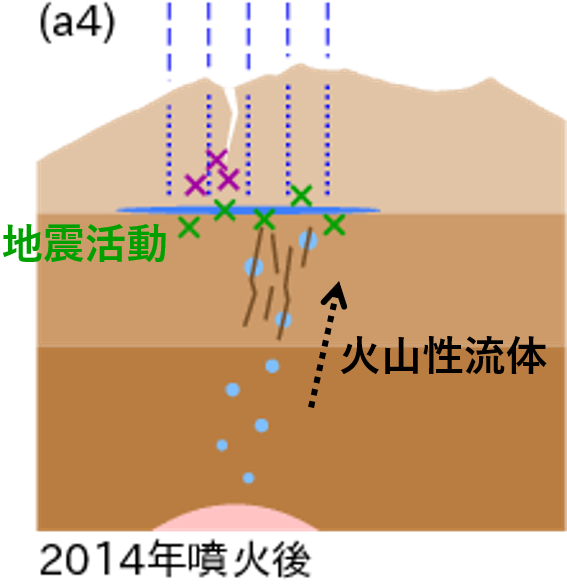
2014年噴火前の地震の多くは古期御嶽層の下端付近で起きていたと推定されます (図1; 但し、当時の地震観測網では震源位置が精度良く求まらないので、 より最近の地震活動パターンを元にした想像です)。 それに対し、2014年噴火以降の地震の多くは 新期御嶽—古期御嶽境界付近で起きていることが分かってきました。 これは、2014年噴火によって古期御嶽層内に亀裂が形成されたことで 以前よりも流体が上昇しやすくなったためと考えられます(図3)。
Most earthquakes before the 2014 eruption are estimated to have occurred at around the bottom of OED (Fig. 1; however, this is just an imagination based on more recent seismicity pattern, not based on direct estimation of hypocenters because of difficulty in the estimation with high accuracy from the observational network at that time). On the contrary, most post-eruptive earthquakes occur near the YED-OED boundary. This change is probably attributed to the fractures in the OED created by the 2014 eruption that increased the permeability in the OED.


図3. 御嶽山2014年噴火以降の流体移動と地震発生過程の模式図。 Maeda et al. (2026)の図を修正。
Fig. 3. Schematic illustration of the fluid movement and seismogenic process after the 2014 eruption of Mt. Ontake; modified from Maeda et al. (2026).

○地下から多量の流体が上昇してくると 古期御嶽—基盤岩境界付近で地震活動が活発化する (Abundant upward migration of fluid activates seismicity around the boundary between older eruptive deposit layer and the basement)

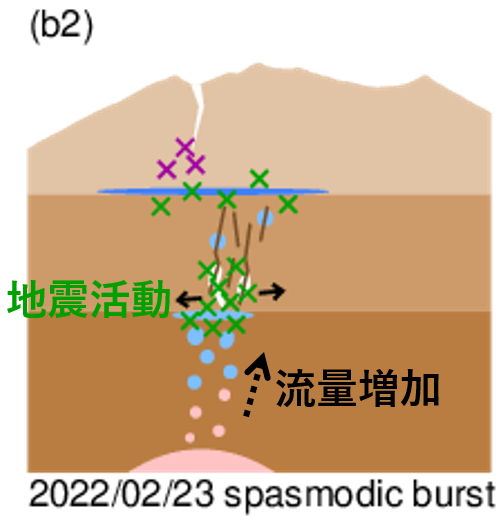
御嶽山では2014年を最後に噴火は起きていませんが(2026年9月末現在)、 噴火前に似た地震活動の活発化が2022年2月〜3月と2024年12月〜2025年1月に観測されました。 これらの活発化期間中の地震の多くは古期御嶽層の下端付近で発生しました。 その理由として、古期御嶽内に亀裂が形成されて流体が上昇しやすくなったとはいっても 元々が流体を通しにくい層ですので捌ける流体の流量には限りがありますので、 その限界を超えて多量の流体が深部から上昇してくると古期御嶽層で堰き止められ、 その下で地震活動が活発化したと考えられます(図4)。
Although the last eruption of Mt. Ontake was in 2014 (as of the end of September 2026), increase in seismicity similar to pre-eruptive periods was observed from February to March 2022 and from December 2024 to January 2025. A majority of earthquakes in these periods occurred at around the bottom of OED. This is probably because of relatively low permeability in the OED even with the 2014 fractures; when the flux of upward migrating fluid exceeds that in the OED, the fluid accumulates near the bottom of the OED and activates the seismicity (Fig. 4).


図4. 御嶽山での地震活動活発化時の流体移動の模式図。 Maeda et al. (2026)の図を修正。
Fig. 4. Schematic illustration of the fluid movement during enhanced seismicity period of Mt. Ontake; modified from Maeda et al. (2026).

○2022年2月23日と2025年1月21日に発生した噴火未遂 (Failed eruptions on February 23, 2022 and January 21, 2025)

御嶽山では2014年噴火開始直前の数分間(9月27日11:45〜11:52頃)に、 多数の地震、微動、ゆっくりした地面の振動、山が膨らむ変動が同時に発生しました。 これとそっくりな現象が2022年2月23日14:15〜14:22頃と、 2025年1月21日16:05〜16:11頃にかけて観測されました。 2022年と2025年のケースでは固形物が空中に飛び出す「噴火」は起きませんでしたが、 地震波の記録から見ると2014年噴火開始直前の数分間とそっくりな現象が 地下では進行していたと考えられます。
The 2014 eruption of Mt. Ontake was preceded for several minutes (around 11:45-11:52 on September 27) by synchronized occurrences of abundant earthquakes, tremor, slow oscillation of the ground, and inflation of the volcano. Similar signals were recorded from 14:15 to 14:22 on February 23, 2022, and from 16:05 to 16:11 on January 21, 2025. These records show than phenomenon similar to the several minutes before the 2014 eruption progressed, although ejection of solid materials to the atmosphere (eruptions) did not occur in 2022 and 2025.

○より詳しくは (More details)

2026年に発表した以下の論文をご覧ください。 日本人の皆様には解説付きの全文和訳をおすすめします。
Read the article below (published in 2026).


トップページに戻る (Back to the top page)